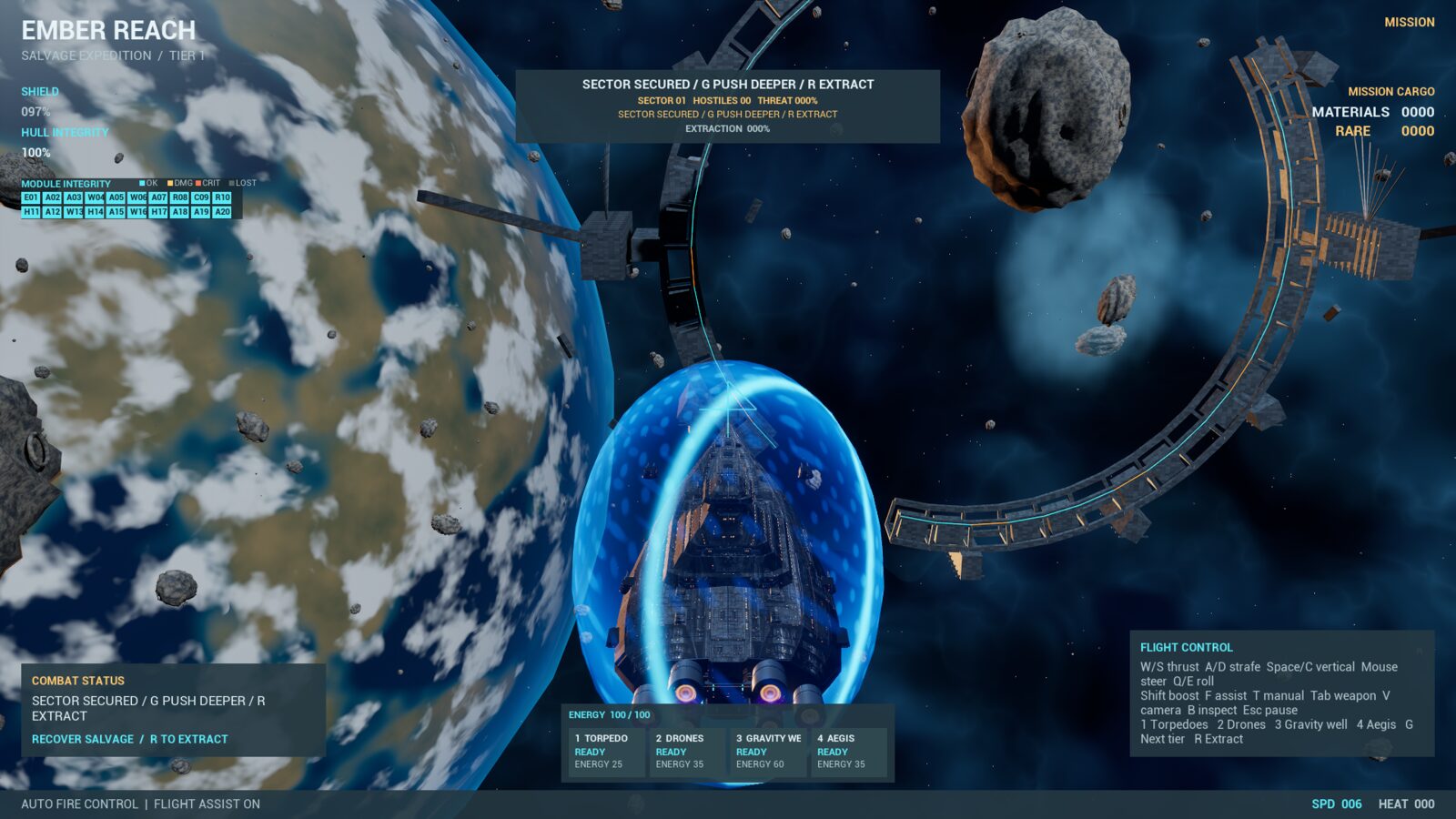
STARSHIPEMBER REACH
A 200-metre capital ship you assemble part by part, fly with six degrees of freedom, and lose piece by piece. Hits open real apertures in the hull and expose the ribs, beams, conduits and machinery underneath. Sever the wrong section and the whole structural group detaches — mass, engines, power and weapon availability change on the spot.
“A new captain. A ship worth bringing home.”
Six degrees of freedom, in real geometry
Thrust runs in the ship's own coordinate system — forward and reverse, strafe, vertical — with independent pitch, yaw and roll, quaternion-relative and capped by angular rate. Nearby space is navigable world geometry, not a backdrop: 420 independent asteroid instances across three meshes, 240 smaller fragments, a broken orbital refinery of 160 main ring beams, three gas volumes and a planet with its own atmosphere. The open ring passage is about 1.1 km across.
Handling — 200 m intact hull
| Assisted cruise | 120 m/s |
| Boost cruise | 296.4 m/s |
| Boost velocity cap | 338 m/s |
| Yaw / Pitch / Roll | 28.00 / 22.00 / 32.00 °/s |
| Angular acceleration | 20.00 °/s² |
Build Ship displays the actual span, rates and a lower bound for a 180° turn. Flight uses the same numbers, and losing engines reduces control authority.
Four abilities, four mounts, one hull that remembers
Abilities
| Ability | Energy | Cooldown | |
|---|---|---|---|
| 1 | Torpedo salvo | 25 | 10 s |
| 2 | Escort drones | 35 | 24 s |
| 3 | Gravity well | 60 | 42 s |
| 4 | Aegis surge | 35 | 28 s |
Ability energy regenerates at 6 per second. Four starting mounts use pulse, laser, missile and torpedo cores; rail and the forged Ember Lance remain available.
Shields, aim and ramming
Remaining solutions scatter around the aim direction. Physical projectile segments and laser traces decide whether a shot lands and which module takes it.
Eclipse Dreadnought
A full expedition holds 21 hostiles across three tiers. In phases 1 and 2 the boss rebuilds its entire original hull in place, restores every module, clears damage apertures, refills 35% shield and protects the hull for 2.5 seconds. Only phase 3 stays dead.
Piercing lance
It passes through hostile ships, cuts the modules in its path and their immediate neighbours, and stops at solid structures. Release early to cancel with no cooldown.
The struck place opens
This is the part the whole demo was built around. Damage is not a health bar with a decal on top — four non-healing local-space apertures per hull section cut through to separately modelled ribs, beams, machinery, conduits and cables.
Repair drones
R sends ten robots. At 3.5 seconds they rebuild missing modules at 25% of maximum HP, add 25% to active ones, reset armor holes and damage lights, and restore 25% of plate capacity. They return after six seconds; the ten-second cooldown starts at deployment. Repair does not refill shields or revive a destroyed command core.
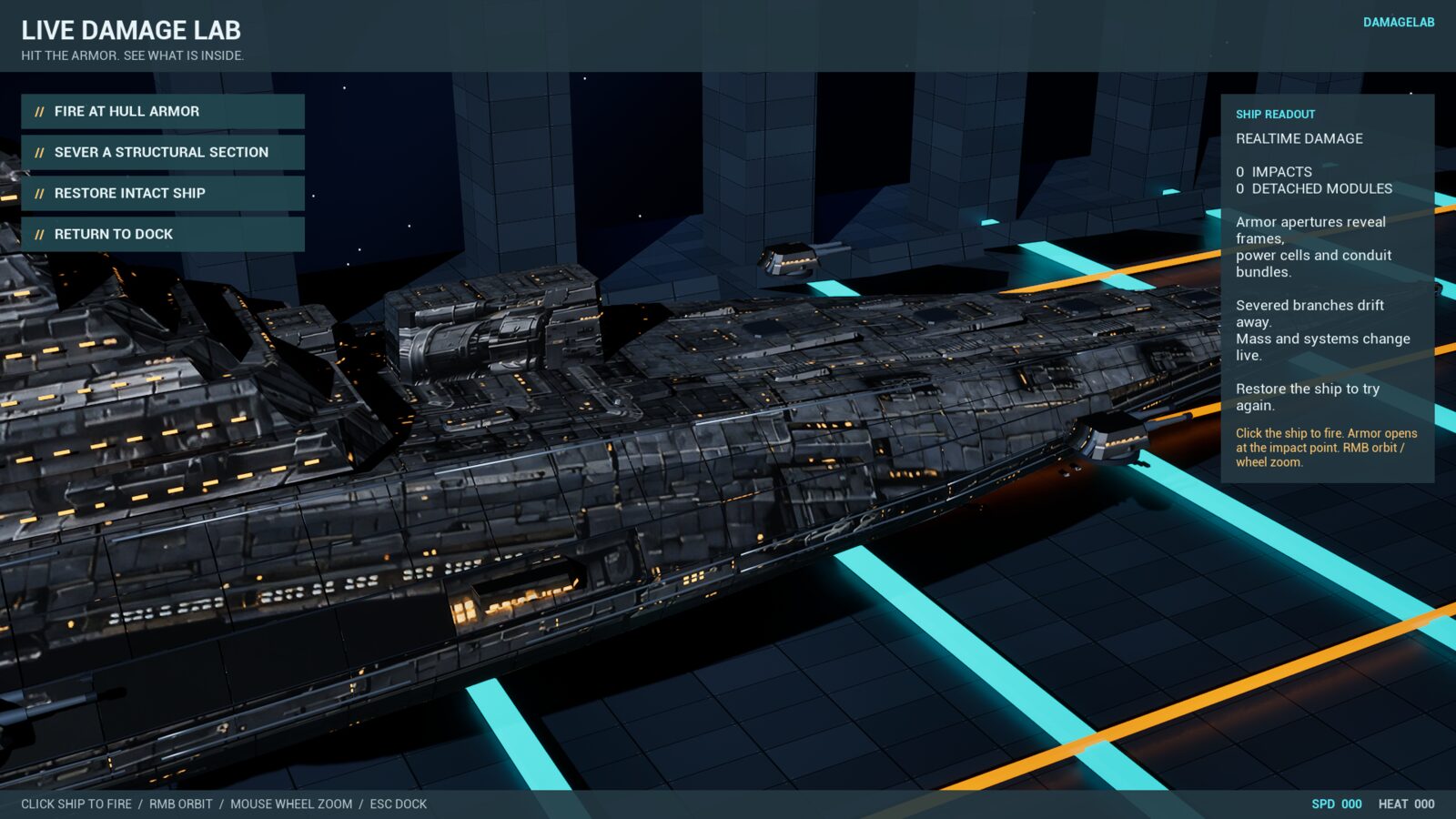
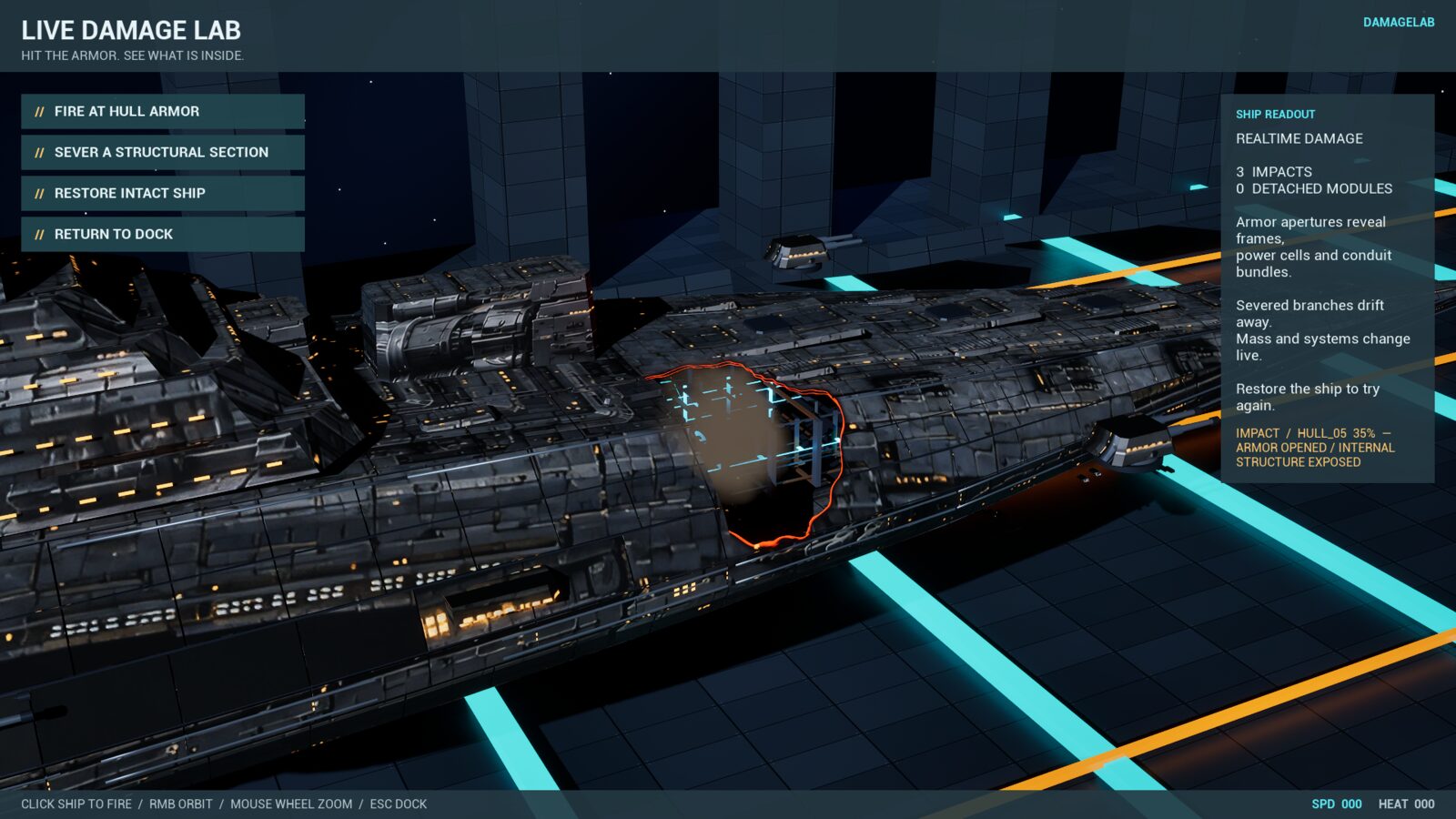
Drag the handle. Same hull, same camera — left is intact, right is four local apertures cut into the same sections.
HUD reads the real ship
Detached and destroyed systems contribute zero. A module grid keeps showing each part on its own.
Honest scope: this is a render-mask aperture over real internal geometry — not a boolean mesh fracture, not arbitrary triangle slicing, and not a traversable interior.
Three layers, one hull
Parts occupy a discrete 3D grid: pick an anchor, click a blue connection point, rotate before placing. Up to 32 parts. Occupied or disconnected placements are rejected outright, and the original detailed hull is retained in every generated ship.
Custom Build
| Main Frame | Cutaway to the core structure for editing |
| Middle Layer | The armor you author yourself |
| Complete Exterior | Install Outer Armor wraps it at 0.5 m clearance |
The exterior consumes no parts, materials or weapon slots and adds independent armor durability without changing module HP or shield maximum. Switching views only changes visibility — your parts stay where you put them.
The Forge
Recipe costs are displayed before every action. Come home first — provisional mission cargo is lost on destruction or abort, while confirmed dock inventory and your design survive.
Six regions. Three ways to lose the cargo.
Regions
| Earth Orbit | Earth, blue atmosphere, a broken orbital refinery |
| Red Frontier | Rust world, mining wrecks, red terrain |
| Ring Sea | Banded gas giant and physical ice rings |
| Ice Veil | Pale blue ice world, frost, a small moon |
| Ember Nebula | A hot star, dark cloud, scattered debris |
| Shattered Moon | Gray moon, exposed faults, drifting fragments |
All six regions support all three modes, using real 3D space geometry and the same flight, damage and weapon systems.
Graphics policy
Auto is the default. Dock, ship construction and Free Flight stay at native 100%. During combat, engine GPU timing adapts dynamic resolution between 60% and 100% with TSR as load requires — output resolution and UI scale never change, and mesh, texture, Lumen and light quality are untouched. Native pins 100%; Quality pins 85%.
Salvage Run
Clear three squadrons and the three-phase Dreadnought. Drops travel to you automatically; press H after completion, or leave early with what you already hold.
Survival
Hold three minutes for 180 materials and 4 rare parts, then +60 and +1 for every extra minute. Maximum 12 active hostiles, and reinforcements keep arriving after the goal — leaving is always a decision.
Fortress Assault
Empty all 64 Iron Citadel sections for 400 materials and 10 rare parts. Guards stop reinforcing at zero — the survivors can still take you on the way out.
CITADEL
64 × 1,800 HP = 115,200 HPThere is no privileged objective core and no four-relay unlock. The bar is simply the sum of every surviving assembly, so attack any surface that is still standing — and the operation completes only when the total reaches zero.
A twelve-kilometre gothic space castle
A broad foundation, a stepped central keep, four split towers, bridges and six open hangars — built from real mesh geometry with query collision, where empty hangar mouths stay empty. Every one of the 64 assemblies owns its hull, buttresses, lights and trim, and every one is damageable on its own.
Assault record
Destruction is at assembly level, consistent with the demo's damage graph — not arbitrary voxel carving. Close-up detail remains simpler than the source reference photograph.
Four seconds between you and the cargo
Press H and loose parts visibly eject and assemble a full 3D mechanical portal of 108 physical pieces. Cancel any time below 3.3 seconds; past that the return is committed, and destruction before departure loses everything unsecured.
Surfaces, up close
The gate, station and arms use modelled 3D geometry with original 4096 × 4096 base colour, normal and roughness maps. Six photo-derived materials override 75 runtime component slots; the shader selects quadrilateral regions from the source pictures and corrects their perspective, rather than pasting an image card into the scene.
The station
Arm placement is a runtime result: the clamps sample the current hull at 28% and 72% of its X extent, trace a visible armor or core section, and derive their own scale from the live bounds.
44 captures from the packaged build
Every image on this site is a runtime capture from the packaged Windows application — no concept art, no bullshots. Click any frame to open it.
What was actually measured
Build
Verification
Performance
1080p, capped at 60, full combat, on an RTX 2080 Ti with no OS or GPU power setting changed. These are combat measurements — not a guarantee of 60 FPS in every scene, and not a 4K claim.
Scope
The save is versioned and checksummed; a corrupt or incompatible profile produces readable recovery feedback instead of silent loss. Normal play runs at 1× stats — the 3× setting exists only inside isolated QA profiles.
Stated plainly
This is an original space-combat demo developed toward a Railjack-class visual reference. Functional 3D verification does not establish equivalence to that production's art, animation, encounter density or polish, and no Warframe image or model is used as a runtime asset. The battle effects are original project content. Automated execution checks do not stand in for independent visual acceptance.